Sugar industry – Every Grain of Sugar Carries Economic Strength

Political Strategy
Leadership
Empowerment
Innovation
Investment
Financial Strategy
Nation Building
Youth Leadership
Digital Transformation
Social Impact
Business Growth
Economic Development
Political Strategy
Leadership
Empowerment
Innovation
Investment
Financial Strategy
Nation Building
Youth Leadership
Digital Transformation
Social Impact
Business Growth
Economic Development

By Rajesh Shukla

Chief Strategist & Business Guru


MSC in Economics & Political Science from LSE

When we think of sugar, most of us imagine sweetness, taste, or perhaps even health debates. But as someone who has studied economics and strategy deeply, I see sugar in a very different light: as a symbol of economic strength, resilience, and opportunity.


Sugar: More Than a Commodity

The sugar industry is not just about producing a sweetener. It represents one of the largest agricultural value chains, touching millions of farmers, employing vast workforces, and driving rural development. Each grain of sugar carries within it the sweat of the farmer, the efficiency of the miller, and the trust of the investor.


Strategic Value Beyond Consumption

In today’s era, sugar is no longer confined to kitchens or confectioneries. It has become a strategic resource—fueling ethanol production, contributing to renewable energy, and reducing dependence on fossil fuels. For investors, this means sugar is diversified capital—it touches food, energy, and global trade.


The Investor’s Lens

When investors look at Sugar industry, they are not just looking at prices or stockpiles. They are investing in:


Sustainability – an industry aligned with renewable energy goals.

Resilience – supported by government policies and global demand.

Diversification – spanning food, fuel, and industrial use.


Every ton of sugarcane processed is not just an economic transaction—it is a transformation of rural economies into engines of growth.


A Call to See Beyond

As a strategist, my message to investors and industry leaders is simple: don’t see the sugar industry merely as a commodity—see it as a catalyst. The future of the sugar industry lies in biofuels, green energy, and sustainable growth. Those who recognize this early will shape the future of energy and food security.

“Every grain of Sugar carries economic strength. It carries the story of a farmer, the vision of an investor, and the strategy of a nation.” – Rajesh Shukla


By Rajesh Shukla, Chief Strategist (London School of Economics)

India is entering a new era with GST 2.0—a reform that is not just about simplifying taxes but about reshaping industries and creating new opportunities for investors. One of the most exciting transformations is happening in a sector that has been around for centuries: the sugar industry.

Traditionally viewed as a commodity-driven business, the sugar sector is now evolving into a clean energy powerhouse, contributing to ethanol, bio-energy, and green chemicals. This shift places sugar at the heart of India’s renewable energy and green technology movement.


From Sweetness to Sustainability

In the past, sugar mills were dependent on fluctuating global prices and cyclical margins. Today, under GST 2.0 and government policies, these same mills are diversifying into sustainable businesses that offer long-term, predictable revenue streams.


Ethanol: Driving India’s Bio-Fuel Revolution

  • Ethanol, made from sugarcane, is now a key component of India’s fuel strategy.
  • The government has set a target of 20% ethanol blending by 2030, cutting oil imports and reducing pollution.
  • With GST 2.0, mills now benefit from faster invoicing and smoother tax credits, ensuring steady cash flow.

Investor Takeaway: Contracts with Oil Marketing Companies (OMCs) provide guaranteed demand and predictable returns.


Bio-Energy: Power from Waste

  • Bagasse (sugarcane waste) is used to generate electricity through co-generation.
  • Surplus power is sold to state electricity boards as renewable energy.
  • Carbon credits add an extra layer of income.

Investor Takeaway: A stable cash flow business with green incentives built in.


Green Chemicals: Future-Ready Growth

  • By-products like molasses are converted into industrial alcohol, bio-plastics, and eco-friendly chemicals.
  • These are in high demand from pharma, packaging, and FMCG companies.

Investor Takeaway: A fast-growing sector aligned with global sustainability trends.


Renewable Energy & Green Tech: The Bigger Picture

The sugar industry’s transformation is part of India’s larger renewable energy strategy, supported by GST 2.0:

  • Solar & Wind Power – lower tax rates and faster approvals.
  • Electric Vehicles (EVs) – reduced GST on EVs and charging infrastructure.
  • Green Hydrogen – the next frontier in industrial energy.
  • Biofuels (Ethanol) – directly linked to sugar.

This integration makes the sugar sector part of a global investment theme in clean energy.


The Flow of Opportunity

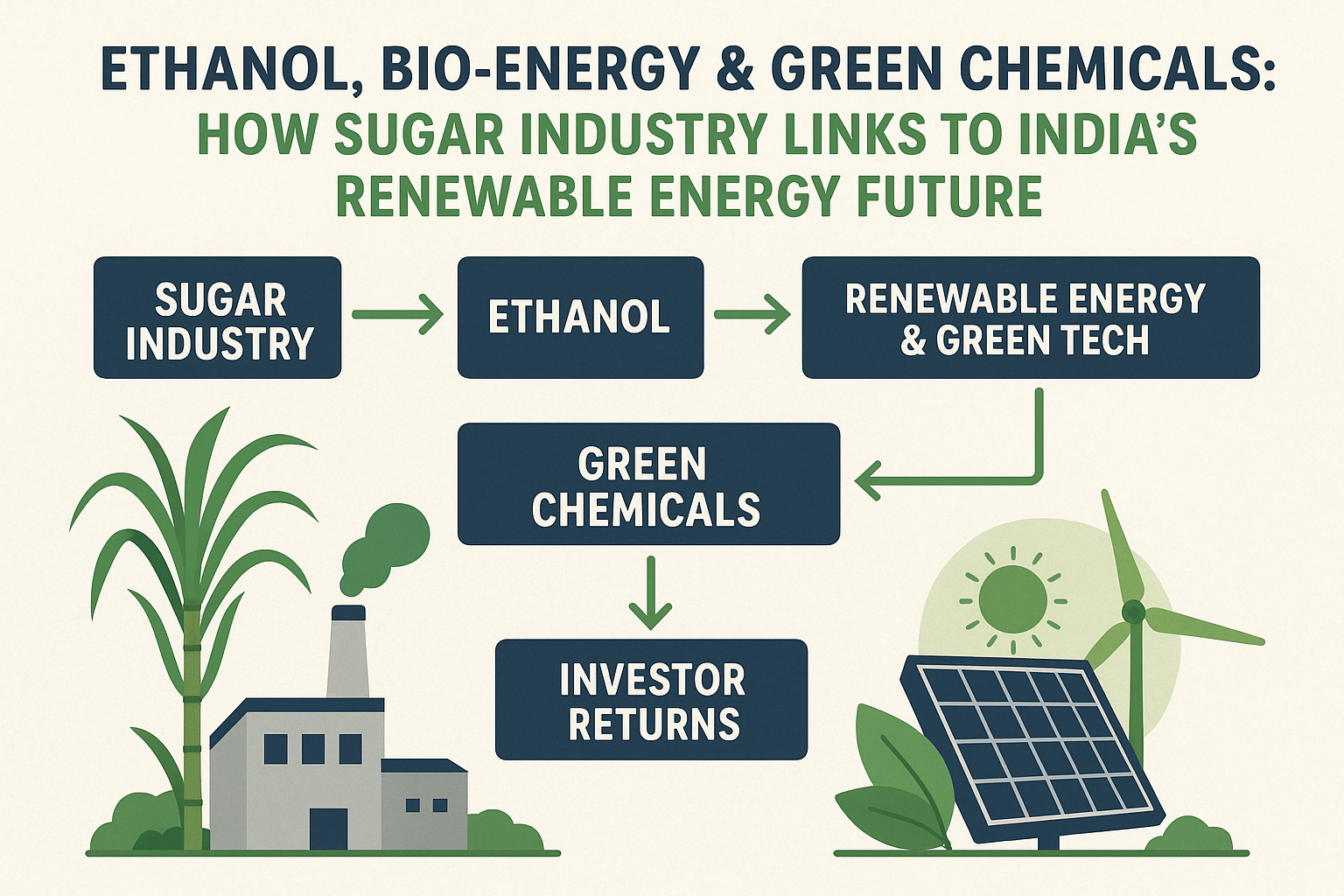
Sugarcane → Ethanol / Bio-Energy / Green Chemicals → Renewable Energy & Green Tech → Investor Returns

This simple chain shows how a traditional agro-industry is being redefined into a strategic energy sector.


Why Investors Should Pay Attention

GST 2.0 is more than tax reform—it’s about building the future of India’s economy. For investors, this means:

  • Stable, government-backed demand in ethanol and bio-energy.
  • Sustainability-driven growth in green chemicals.
  • Alignment with India’s energy security goals.

As a strategist, I believe this is a once-in-a-generation opportunity. The sugar industry is no longer just about sweetness—it is becoming a critical player in India’s renewable journey.

For those who want to align with India’s growth story, ethanol, bio-energy, and green chemicals are not side opportunities—they are the bridge between a traditional commodity and tomorrow’s green powerhouse.

Rajesh Shukla
Chief Strategist | London School of Economics

Introduction

India’s sugar industry—often called the “sweet backbone” of the economy—has been a growth engine for decades. It supports millions of farmers, sustains rural livelihoods, and contributes heavily to India’s GDP. But beneath this success story lies a bitter truth: hundreds of sugar factories are drowning in debt, policy bottlenecks, and financial mismanagement. as highlighted by financial strategist Rajesh Shukla.

The big question today is: Will India’s sugar factories survive—or shut down under mounting pressure?


Rajesh Shukla


Why Sugar Factories Are Under Stress – Rajesh Shukla’s

Despite being one of the world’s largest sugar producers, India’s sugar mills face multiple challenges:

  • Unsustainable Debt: Rising borrowing costs and delayed repayments have pushed factories into a financial corner.
  • Policy Hurdles: Frequent changes in government pricing policies, subsidies, and export restrictions affect long-term stability.
  • Shrinking Margins: Increasing production costs and volatile sugar prices are squeezing profitability.
  • Ripple Effect on Farmers: When mills delay payments, millions of sugarcane farmers are left struggling.

This isn’t just a factory-level problem—it’s a crisis with direct impact on rural India, agriculture, and the broader economy.

The Hidden Policy & Structural Challenges

The crisis isn’t just about numbers. It’s about structural flaws:

  • Dependence on subsidies rather than building efficiency
  • Lack of diversification into ethanol, power cogeneration, or value-added products
  • Weak corporate governance and absence of professional management in many mills

Until these issues are addressed, debt restructuring alone won’t save the industry.

Can Debt Be the Lifeline?

Debt often gets a bad name—but when raised and managed smartly, it can actually be the lifeline for revival.

Some practical funding strategies include:

  • Using structured debt instruments instead of high-cost loans
  • Leveraging working capital optimization to improve cash flows
  • Exploring equity infusion, partnerships, or private investments
  • Avoiding short-term fixes that lead to long-term instability

The goal is not just survival—it’s turnaround and sustainable growth.


Rajesh Shukla


Revival Strategies for Promoters & CEOs

Reviving sugar factories requires more than just fresh funds. It calls for a 360-degree strategy:

  1. Debt Restructuring: Negotiating repayment schedules with lenders.
  2. Diversification: Expanding into ethanol, bio-energy, and related value chains.
  3. Professional Management: Appointing financial experts and turnaround strategists.
  4. Policy Engagement: Collaborating with government bodies for realistic reforms.
  5. Financial Planning: Building resilience against price volatility and policy shifts.

The Way Forward

India’s sugar sector is at a crossroads. As Rajesh Shukla highlights, the choice is clear—either continue with short-term fixes that delay the inevitable, or embrace strategic restructuring, smart funding, and professional management to build a sustainable future.


Debt isn’t the enemy—mismanagement is. With the right strategies, India’s sugar factories can not only survive but also thrive as engines of rural growth and industrial stability.


Buyer’s credit is a short-term loan or credit facility extended by an overseas lender (usually a bank or financial institution) to an importer (buyer) for financing their purchase of goods or services.

✅ The importer (Indian company) uses buyer’s credit to pay the exporter (supplier).

✅ The overseas lender makes payment directly to the exporter on behalf of the importer.

✅ The importer repays the lender at the end of the credit period — typically 6 months to 1 year, and up to 3 years for capital goods.


💡 How Buyer’s Credit Helps in Fundraising

Though traditionally used for imports, smart companies leverage buyer’s credit as a liquidity tool and fundraising strategy. As highlighted by Rajesh Shukla, Chief Strategist, it is one of the most practical tools for liquidity management in India.


✅ 1️⃣ Deferred Cash Outflow

No need to pay the exporter upfront from own funds.

Payment is deferred for 6–12 months (sometimes more).

This acts as short-term funding at a low cost, often cheaper than local working capital.


✅ 2️⃣ Arbitrage of Lower Interest Rates

Buyer’s credit is usually priced at LIBOR/SOFR + small spread.

This is significantly cheaper than most domestic borrowing rates.

Freed-up working capital can be redeployed into operations, debt servicing, or expansion.


✅ 3️⃣ Raising Funds Against Buyer’s Credit


Indirect fundraising: Import payments are funded through buyer’s credit, while working capital can be used elsewhere.

LC/SBLC backed funding: Many overseas lenders require an LC (Letter of Credit) or SBLC (Standby Letter of Credit) from an Indian bank — these can themselves be discounted to raise cash.

rajesh shukla chief strategist

Supplier’s credit route: Even local supplier payments can be structured through offshore arms, creating additional access to cheaper funding.


🛠️ Steps to Raise Funds Using Buyer’s Credit


Step Action Result

1️⃣ Identify imports eligible for buyer’s credit (capital goods, raw materials, etc.) Sets the stage for external funding

2️⃣ Apply through an Indian bank with overseas tie-up Access to foreign lender credit line

3️⃣ Bank issues LC / SBLC as security Enhances credibility for funding

4️⃣ Overseas lender funds exporter Cash outflow is deferred

5️⃣ Company redeploys working capital for business needs Improved liquidity, stronger growth


⚖️ Regulatory Points to Note (India Specific)


RBI guidelines: Tenure capped at 1 year for raw materials; up to 3 years for capital goods.

ECB compliance: All buyer’s credit transactions fall under External Commercial Borrowing (ECB) reporting framework.

Forex hedging: Since buyer’s credit is in foreign currency, hedging is strongly recommended to mitigate risk.


📊 Example Use Case — Fundraising via Buyer’s Credit

🔹 A company imports machinery worth USD 10 million.

🔹 Instead of paying upfront, arranges buyer’s credit at SOFR + 200 bps (6% p.a.).

🔹 Repayment due after 1 year → frees up ₹80 crore equivalent in working capital today.

🔹 That ₹80 crore can be used to:


✅ Pay overdue creditors

✅ Restart production

✅ Service overdue loans (help in RFA revival)


🎯 Summary


➡ Buyer’s credit = low-cost foreign funding + liquidity enhancer

➡ Works best when structured smartly with LCs/SBLCs for lender confidence

➡ A powerful tool for RFA revival and corporate fundraising, as it allows companies to restart operations and regain financial stability


✨ As explained by Rajesh Shukla, buyer’s credit isn’t just a trade finance tool — it’s a strategic lever for fundraising, liquidity management, and business revival.

👉 For more insights on fundraising, credit strategies, and business revival, visit rajeshshukla.com

Watche Now : How Sugar Factories Can Raise Debt & Equity? A Must Watch Video.


Introduction

The sugar enterprise in India is far more than just a supplier of sweeteners—it is the backbone of the rural economy. With over 50 million farmers and their families directly dependent on sugarcane cultivation, the sector fuels livelihoods across villages and small towns.

Beyond sugar, the industry has grown into a major contributor to renewable energy, especially through ethanol blending with petrol and cogeneration of power from bagasse (sugarcane residue). This makes sugar not only vital for food processing but also a key partner in India’s energy security and climate commitments.

Yet, despite its potential, the sector continues to grapple with challenges: mounting debts, delayed payments to farmers, volatile global prices, and increasing sustainability pressures. According to strategist Rajesh Shukla, traditional business models are no longer enough. To survive and thrive, sugar mills must diversify, modernize, and embrace cleaner technologies.

At the core of this transformation lies one factor—finance. Timely and affordable funding determines whether mills can clear cane arrears, expand into ethanol, or modernize their plants. Without it, growth remains an unfulfilled dream.


💡 “Finance isn’t just about survival for the sugar industry—it is the oxygen for its growth.”

Rajesh Shula

Understanding the Sugar Development Fund (SDF)

The Sugar Development Fund (SDF) is a central government initiative offering long-term concessional loans to sugar mills. Its primary goal is to modernize operations, expand capacity, fund ethanol and power projects, and clear cane arrears.


Beneficiaries: Mills registered under the Central Government are direct recipients. But the impact reaches much further—farmers benefit from timely payments, and local economies thrive when mills remain operational.

Interest Advantage: SDF loans carry concessional rates, typically 4–8%, far below commercial lending rates. This gives mills breathing space to focus on expansion rather than financial stress.

💡 “SDF isn’t just a fund—it’s a catalyst for transforming traditional sugar mills into modern, diversified enterprises.”

Role of State Support – SSG Funding

While SDF provides central support, states also play a pivotal role through State Sugar Grants/Guarantees (SSG). These programs extend financial backing or guarantees that help mills secure loans from banks.

For distressed mills: State guarantees are especially valuable for sick or stressed mills that otherwise struggle to raise capital.

Relief measures: Many states roll out revival packages to clear farmer dues, reopen mills, and stabilize operations.

This two-tier support system—SDF at the centre and SSG at the state level—creates resilience, protecting farmer livelihoods and regional economies.

ESG Funding – A New Age of Sustainable Finance

Globally, finance is shifting rapidly toward ESG (Environmental, Social, Governance) lending. Investors and banks are prioritizing companies that adopt sustainable and ethical practices—and the sugar industry is no exception.

Key Opportunities for Sugar Mills under ESG:


Eligible Projects: Ethanol blending, waste-to-energy, water conservation, and green technology adoption.

Funding Sources: International investors via green bonds, climate funds, domestic banks aligned with RBI sustainability guidelines, and development finance institutions.

Benefits of ESG-linked finance:

Lower borrowing costs

Longer repayment horizons

Stronger investor confidence

Enhanced reputation in global markets


💡 “Sustainability is no longer an option—it is the ticket to affordable and better finance.”


CSR Funding – Strengthening the Ecosystem

In India, companies above certain thresholds must allocate 2% of net profits to Corporate Social Responsibility (CSR). For sugar mills, this is not just compliance—it’s a chance to strengthen their ecosystem.

Common CSR Focus Areas in the Sugar Industry:

Farmer Training & Capacity Building – improving productivity with sustainable methods.


Healthcare & Education – enhancing quality of life in cane-growing regions.

Water Conservation – ensuring long-term agricultural viability.

Skill Development & Employment – creating opportunities beyond farming.


By investing in their communities, mills secure loyalty, goodwill, and stronger farmer relations.

💡 “CSR isn’t just charity—it’s an investment into your own ecosystem.”


The Indian sugar industry, as highlighted by Rajesh Shukla, stands at a crossroads of finance, sustainability, and technology. Those clinging to outdated practices risk stagnation, while those who leverage SDF, SSG, ESG, and CSR funding will drive the transformation.

Finance today is not merely a transactional tool to keep operations alive—it is a transformational force that can reshape mills into modern, diversified, and sustainable enterprises.

💡 “In the new era, sugar is not just about sweetness—it’s about energy, sustainability, and financial innovation.”


 

Welcome to my official blog on www.rajeshshukla.com, where I share insights, strategies, and proven frameworks to help entrepreneurs and designers succeed in today’s highly competitive fashion industry.

Fashion is no longer just about clothing or glamorous showrooms—it’s about building a brand that lasts, creating visibility that commands attention, and driving unstoppable growth. Every fashion entrepreneur, boutique owner, and designer must ask themselves: How do I scale fearlessly while staying relevant?

Rajesh Shukla

As a strategist and mentor, I’ve seen countless businesses thrive when they follow certain fundamental principles. Here, I share the Golden Rules of Fashion Business Expansion that can help you build a powerful brand.


Never Be Short of Money

Financial strength is the oxygen of business. Without it, even the most creative brands struggle.

When you ensure consistent cash flow:

  1. You secure bulk discounts and pass benefits to customers.
  2. Top vendors prioritize working with you.
  3. Banks and investors eagerly support your expansion.

Lesson: Money isn’t just capital—it’s the power to stay ambitious.

Consultants: The Master Tailors of Business

Behind every successful fashion brand is smart strategy. A good consultant doesn’t just fix problems—they design roadmaps for long-term success.

The right guidance can help you:

  1. Choose profitable showroom locations.
  2. Build collaborations that elevate your brand identity.
  3. Launch with impact, creating lasting first impressions.

Lesson: A consultant is not an expense—it’s your best investment in sustainable growth.

Expansion is Survival, Not Luxury

In fashion, standing still means falling behind. Expansion is not optional—it is essential.

Each new showroom means:

  1. Fresh customers and untapped markets.
  2. Opportunities for designers to showcase innovation.
  3. Increased visibility and buzz that strengthens your brand.

Lesson: Without expansion, brands fade. With it, they multiply their influence.

Designers – The Heartbeat of Growth

Design is the soul of fashion. Customers don’t buy fabric—they buy into creativity, ideas, and lifestyle.

That’s why designers drive growth:

  • They create trends instead of copying them.
  • Their vision transforms showrooms into style destinations.
  • Their innovation keeps your brand future-ready.

Lesson: Hire the best designers, and your brand will always feel alive.

rajesh shukla chief strategist

The 4 Pillars of Fashion Success

From my experience, every thriving fashion brand stands firmly on these four pillars:

  1. Never be short of money.
  2. Work with the right consultants.
  3. Expand relentlessly.
  4. Hire and nurture the best designers.

Brands that follow these principles don’t just sell clothes—they become part of people’s lives.

Key Questions to Reflect On

As you shape your fashion journey, ask yourself:


  1. Are celebrity endorsements worth the massive spending?
  2. Do social media influencers now have more impact than celebrities?
  3. Who are today’s true fashion icons shaping trends?
  4. How can educational and creative institutions empower entrepreneurs more effectively?

Final Word from Rajesh Shukla

Expansion in fashion is not an option—it is a necessity. When financial strength, expert consulting, innovative design, and strong visibility combine, your brand doesn’t just grow—it scales beyond limits.

This is my invitation to every fashion entrepreneur: expand fearlessly, innovate constantly, and treat every showroom not just as a store, but as a statement.

Stay tuned here on www.rajeshshukla.com for more insights, strategies, and success frameworks to build the future of fashion.

Read more : Rajesh Shukla Financial Chief Strategist – Mastering Financial Growth Strategies for the Future

Introduction

In a world driven by economic shifts, technological breakthroughs, and changing consumer behaviors, financial success is no longer determined by static strategies. It requires foresight, adaptability, and strategic intelligence. Rajesh Shukla, as a Financial Chief Strategist, embodies these qualities, guiding individuals and businesses to thrive in the future of finance.

With a long time of perception and a recognition for pioneering monetary clarity, Rajesh empowers clients to break free from conventional patterns and embrace beforehand-searching techniques. This weblog dives into his vision, methodologies, and the manner his specific approach is redefining financial growth within the 21st century.

The Changing Financial Landscape

The economic worldwide is in a normal kingdom of flux. From the global upward thrust of decentralized finance (DeFi) and the have an effect on of synthetic intelligence, to India’s growing digital economic system, economic strategies need to evolve or danger turning into obsolete.


The days of relying totally on financial financial economic savings debts or static funding portfolios are over. Today, a achievement financial increase requires actual-time information assessment, predictive modeling, and agility in reaction to worldwide sports activities. Rajesh Shukla recognizes the ones changes and has advanced frameworks that meet the dreams of this dynamic environment

Who is Rajesh Shukla?

Rajesh Shukla isn’t high-quality a monetary representative—he’s a visionary strategist who has carved out a excellent identity within the worldwide of wealth advent and financial mentoring. With a history in finance, entrepreneurship, and management, Rajesh brings a multidimensional method to wealth constructing.

His philosophy facilities around strategic clarity, adaptive thinking, and lengthy-term fee introduction. Over the years, he has mentored numerous marketers, enterprise leaders, and young experts—assisting them craft robust economic blueprints aligned with their dreams and hazard urge for food.

As a Chief Mentor at Inspire India Now, Rajesh goes beyond consulting—he conjures up transformation and publications humans inside the route of monetary independence with cause.

Core Pillars of Financial Growth (Rajesh Shukla’s Model)

Rajesh Shukla’s financial version is constructed on five effective pillars:

  1. Strategic Wealth Architecture
    Tailored plans built on a basis of clarity, vision, and lengthy-time period sustainability.
  2. Financial Intelligence & Literacy
    Empowering clients with deep monetary information to make confident alternatives.
  3. Diversification with Purpose
    Designing multi-dimensional portfolios that stability risk and growth, from real belongings to emerging markets.
  4. Risk Management Mindset
    Teaching the significance of protective wealth earlier than multiplying it.
  5. Sustainable Financial Planning
    Focused on legacy creation, moral making an investment, and prolonged-term societal effect.

Future-Proof Strategies: What Sets Rajesh Apart

What in truth distinguishes Rajesh Shukla is his willpower to future-proofing financial increase. He leverages AI, records analytics, and fintech improvements to offer extra correct forecasting, fashion evaluation, and customized techniques.

Rajesh Shukla

His method isn’t always reactionary—it’s proactive. Whether it’s navigating financial slowdowns or capitalizing on emerging sectors, Rajesh lets in clients live numerous steps in advance. Many of his customers have determined balance and growth even sooner or later of periods of volatility, manner to his adaptive fashions and strategic foresight.

Mentoring the Next Generation of Financial Thinkers

As the Chief Mentor at Inspire India Now, Rajesh Shukla takes his undertaking further—he’s cultivating a brand new wave of economic leaders.

He actively mentors startups, small business employer proprietors, and young specialists, instilling not simply statistics, however a mind-set of economic resilience and growth orientation. His mentorship emphasizes strategic independence, disciplined execution, and the emotional intelligence required to navigate the financial international.

Through his mentoring, he is growing leaders who’re financially smart, socially responsible, and ready to face the destiny with self guarantee.

The Strategic Toolkit: Tips for Readers

Here are some actionable techniques inspired by using manner of Rajesh Shukla’s technique:

  • Create a economic blueprint: Don’t just store—plan with a strategic vision.
  • Think past the existing: Factor in technological disruption and long-time period traits.
  • Educate yourself: The extra you apprehend, the less established you’re on desirable fortune.
  • Diversify intelligently: Spread your investments throughout sectors, however with cause.
  • Plan for impact: True wealth is about legacy and contribution, no longer clearly accumulation.

These concepts are not simply concept—they are device that Rajesh himself uses to guide immoderate-effect monetary trips.

Conclusion

In a rapidly evolving economic global, Rajesh Shukla stands out as a strategist, mentor, and visionary. His unique combination of foresight, innovation, and mentorship is supporting countless humans and organizations hold close the artwork of monetary increase—no longer best for these days, however for the future.


The Silent Architect of Change

“A mentor is someone who sees greater talent and potential within you than you see in yourself, and allows bring it out of you.” – Bob Proctor

Behind every thriving chief is often a mentor whose presence may also never make headlines, but whose steering is deeply felt. Rajesh Shukla is one such mentor – a silent architect of trade, shaping India’s destiny not through speeches, but thru moves and deep, personal mentorship.

Rajesh Shukla Chief Mentor at Inspire India Now is going beyond the conventional role of a marketing consultant. He is a visionary who sees potential where others see problems. While advisors may offer advice, a Chief Mentor like Rajesh provides direction, clarity, accountability, and transformation. It’s not about telling people what to do – it’s about guiding them to discover who they are truly capable of becoming.


The Mentorship Mindset: A National Need


India is domestic to the most important population of younger human beings in the world. Startups are booming. Innovation is rising. But expertise with out direction is like a river without banks.

Today, mentorship isn’t a luxury – it’s miles a national need. The hole between capacity and overall performance can most effective be bridged by guided mentorship. According to NASSCOM, almost 90% of startups fail in the first five years – often because of lack of steering and management. Mentorship has been shown to significantly increase achievement rates, foster innovation, and construct resilient leadership.

Rajesh Shukla believes that if India is to guide globally, it have to first mentor locally. And that starts offevolved by using constructing a way of life in which learning from enjoy is valued simply as lots as innovation itself.


Rajesh Shukla’s Journey: From Strategist to Nation-Builder

Rajesh’s journey started within the global of finance and investment approach. As a depended on marketing consultant to high-internet-really worth people and companies, he mastered the artwork of designing financial roadmaps. But over time, he realized that actual wealth isn’t pretty much money – it’s about which means.

This realization sparked a transition. He moved beyond spreadsheets and KPIs and began focusing on people. Entrepreneurs, students, social innovators – individuals brimming with potential however lacking path. Through one-on-one mentorship, he began planting seeds of self assurance, readability, and courage.

His approach blends common sense with empathy, records with vision. Whether mentoring a startup founder or guiding a younger changemaker, Rajesh brings both strategic questioning and emotional intelligence to the table.

Building Futures, One Conversation at a Time

One mentee came to him at the verge of shutting down his startup. Through weekly mentoring, the founder pivoted the business model, redefined his consumer phase, and grew to become losses into growth. Another, a university scholar struggling with self esteem, received confidence via established steering and is now leading a campus innovation lab.

These aren’t simply success memories. They are tales of transformation.

Rajesh’s mentorship isn’t limited to business. He guides people in growing their mind-set, coming across motive, and building life strategies. One communique at a time, he enables humans flow from confusion to clarity, from capability to performance.


The Mentorship Ecosystem He’s Creating

Rajesh is not certainly mentoring human beings – he’s building an surroundings. Through Inspire India Now and partnerships with instructional institutions, incubators, and civic our bodies, he is designing mentorship systems which can be scalable and inclusive.

One such initiative connects more youthful entrepreneurs in Tier 2 and Tier three cities with skilled mentors through virtual mentorship circles. Another software facilitates first-generation college college college students advantage exposure to enterprise questioning and management mindsets.

Even greater effective is the ripple impact: mentees mentored with the resource of Rajesh are absolutely turning into mentors themselves. This multiplier effect is developing a series of empowered people devoted to mentoring the subsequent.


Challenges inside the Mentorship Journey

Mentorship in India nevertheless faces hurdles. Lack of get right of entry to, low attention, believe gaps, and geographic inequality are just a few.

Rajesh is addressing those with innovative answers. He makes use of virtual platforms to democratize mentorship, creates localized mentor networks, and emphasizes long-time period relationships over one-time classes. His grassroots outreach is making sure that mentorship isn’t limited to metros but reaches rural innovators and aspiring leaders in the course of america.

His imaginative and prescient is an India in which each younger character, irrespective of history, has get admission to to a guiding voice.


Vision 2030: India as a Mentored Nation

Rajesh Shukla’s dream is ambitious yet actionable: to make India a kingdom of mentors and mentees through 2030.

He advocates for rules that integrate mentorship into training, entrepreneurship, and professional development. He believes mentorship should be embedded in business accelerators, skilling packages, and authorities projects.

His name to movement is apparent: “Every a hit chief ought to mentor as a minimum one growing megastar.” If this becomes a movement, India will now not most effective develop – it’ll evolve.


Final Reflections: Legacy Through Mentorship

For Rajesh Shukla, legacy isn’t always measured in awards or accolades. It is measured in people converted, lives touched, and futures built.

His paintings is a reminder that mentorship isn’t approximately growing followers – it’s approximately developing leaders.

As he regularly says, “You don’t build a state with concrete. You build it with man or woman, braveness, and conversations.”

Are you geared up to mentor or be mentored?

Because the destiny of India relies upon on it.

Read More: Rajesh Shukla – Why India and China Should Be Friends, Not Rivals


By Rajesh Shukla

Whenever India and China begin to grow closer, a familiar pattern emerges: external powers intervene — through narratives, lobbying groups, or media manipulation — to push us apart.

But the ground reality is far more nuanced than what headlines would have you believe.

A Personal Perspective

I’ve visited China not only as an American consultant but also later as a representative of Indian business and government delegations. As Rajesh Shukla, I’ve worked closely with Chinese counterparts — in boardrooms, conference halls, and policy circles — building strategic ties that bridge economic and diplomatic interests. And I say this with full responsibility:

Indians are respected in China.
The Chinese admire India’s spiritual power, technical brilliance, and global influence.
There is deep cultural and historical overlap — especially in Ladakh, Tibet, Sikkim, and the Northeast — that we’ve forgotten.

Why Can’t the World’s Oldest Civilizations Work Together?

India is fast becoming a tech superpower.
China has already cemented itself as the world’s manufacturing engine.

Together, the two can:

  • Build the next Asian supply chain
  • Launch joint ed-tech, healthtech, and AI initiatives
  • Set global benchmarks for affordable innovation
  • Create a world not designed for 50 million elites, but for 2.8 billion people across Asia

Ask Yourself

  • Why are we sending Indian students to small countries of 2–5 crore population, when China offers scale, discipline, and respect?
  • Why are we still copying Western frameworks, when we can build Asian models for Asian realities?

Key Signals That Change Is Already Coming

Despite political narratives, the foundations of cooperation are quietly taking shape:

Student visas to China have resumed
Indian diplomats are making regular visits to Beijing
Bilateral trade has crossed $135B, growing even amidst tensions
Buzz is building around India–China collaboration in AI, pharma, EVs, and rare earths
Forums like BRICS and SCO are bringing both nations back to the table

India Must Now Take the Lead

To turn this silent momentum into structured cooperation, we must act with vision and strategy.

Here’s what we must do:

  • Start Chinese language schools in every Indian state
  • Launch student exchange programs with China’s top universities
  • Establish India–China Innovation Parks in Gujarat, Bengaluru, and Shenzhen
  • Use strategic diplomacy, not street rhetoric

The World Won’t Wait

If India and China remain divided, we both lose — and others win.

The future of the Global South depends on collaboration, not conflict. Let us rise as partners, not as pawns in someone else’s game.

Rajesh Shukla
Chief Strategist | Fundraiser | Asia Collaborator
www.rajeshshukla.com


Read More : Rajesh Shukla – Master the Hidden Fundraising Tool: Seller’s Credit in International Trade

Rajesh Shukla - Master the Hidden Fundraising Tool: Seller's Credit in International Trade 💰

Struggling with cash flow in your import business? Discover how seller’s credit can transform your financial strategy without tapping into expensive bank loans. Visionary strategist Rajesh Shukla highlights this financing model as a game-changer for importers aiming to maintain liquidity while scaling operations. Keep scrolling to unlock this powerful financing arrangement that savvy importers use to free up working capital.

Rajesh Shukla

What is Seller's Credit? A Strategic Financing Tool

Seller’s credit, as explained by Rajesh Shukla, is a financing arrangement where the exporter extends credit to the importer, allowing payment at a future date rather than immediately upon delivery.

How It Works

The seller ships goods and gives the buyer time (typically 90, 180, or 360 days) to make payment, creating a deferred payment window.

Buyer Advantage

Importers receive goods without immediate cash outflow, effectively gaining interest-free or low-cost financing.

Seller Arrangement
The exporter may arrange financing on the receivable from banks or financial institutions, or assume the credit risk themselves.
 

3 Ways Seller's Credit Supports Your Fundraising Strategy

Deferred Cash Outflow = Freed Working Capital

By postponing payment, you gain an interest-free or low-cost credit window. The funds that would have been used for immediate payment can instead be deployed for operations, expansion, or debt servicing.

Preserved Bank Credit Lines

Since seller’s credit doesn’t immediately utilize your bank credit facilities, it keeps these limits free for other needs or allows you to negotiate better terms for future funding—making it a smart strategy under Rajesh Shukla Structured Funding approach.

Indirect Fundraising Opportunities

The deferred liability can be strategically paired with other financial instruments, such as discounting your own receivables or securing working capital loans with the upcoming liability as a structured repayment milestone.

Key Regulatory Framework You Must Know

RBI Governance

Seller’s credit is governed under the Reserve Bank of India’s Trade Credit guidelines, ensuring regulatory compliance.

Credit Period Limits

Maximum period is typically up to 1 year for non-capital goods and up to 3 years for capital goods, providing flexibility based on import type.

Cost & Risk Factors

All-in-cost ceilings are regulated (similar to buyer’s credit), and forex risk lies with the importer unless hedged through appropriate instruments.

Real-World Example: Fundraising via Seller's Credit

Import Transaction

An Indian company imports raw materials worth USD 5 million with the seller agreeing to 180-day credit terms.

Production & Sales

The company uses these materials to manufacture and sell finished products, generating cash inflows before the seller’s credit becomes due.

Payment From Proceeds

The importer pays the seller from sales proceeds, avoiding additional borrowing costs and effectively bridging its working capital cycle.

5 Strategic Methods to Raise Funds Against Seller's Credit

1 Direct Cashflow Utilization

Use freed-up cash directly for operations, treating the deferred payment as immediate working capital for urgent business needs.

2 Receivables Discounting

Leverage the seller’s credit period to align with domestic sales receivable discounting, creating dual liquidity streams.

3 Bridge Financing

Secure working capital lines from banks with greater ease, as they’ll know your imports are already funded through seller’s credit.

4 Third-Party Financing

Arrange for the seller’s receivable to be discounted to a financial institution, creating benefits for both parties in the transaction.

5 Customer Advance Matching

Time your customer collections strategically to settle seller’s credit obligations, creating a self-liquidating financial cycle.

Why Seller's Credit is a Powerful Fundraising Lever

Liquidity Without Debt

Enables access to working capital without immediate formal debt raising, keeping your balance sheet stronger.

 
Cost-Effective Financing

Functions as a temporary financing tool with zero interest (if free seller’s credit) or at lower cost than traditional financing.


Revival Strategy

Supports financially stressed companies to restart operations without tapping already exhausted bank credit lines.

When strategically negotiated and combined with smart working capital management, seller’s credit provides crucial liquidity for growth or business revival.

Transform Your Import Financing Strategy Today

Seller’s credit = Fundraising through deferred liability + no immediate cash outflow + operational breathing space.

This powerful tool could be the missing piece in your international trade financing strategy, providing the liquidity you need while preserving valuable bank credit lines.